
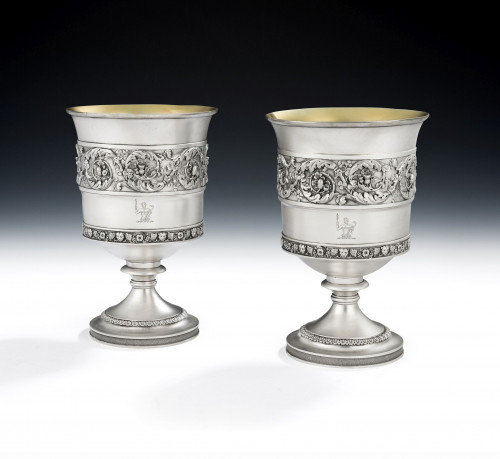
MATTHEW BOULTON. A very fine and unusual pair of George IV Wine Coasters made in London in 1827 by the Matthew Boulton Company.
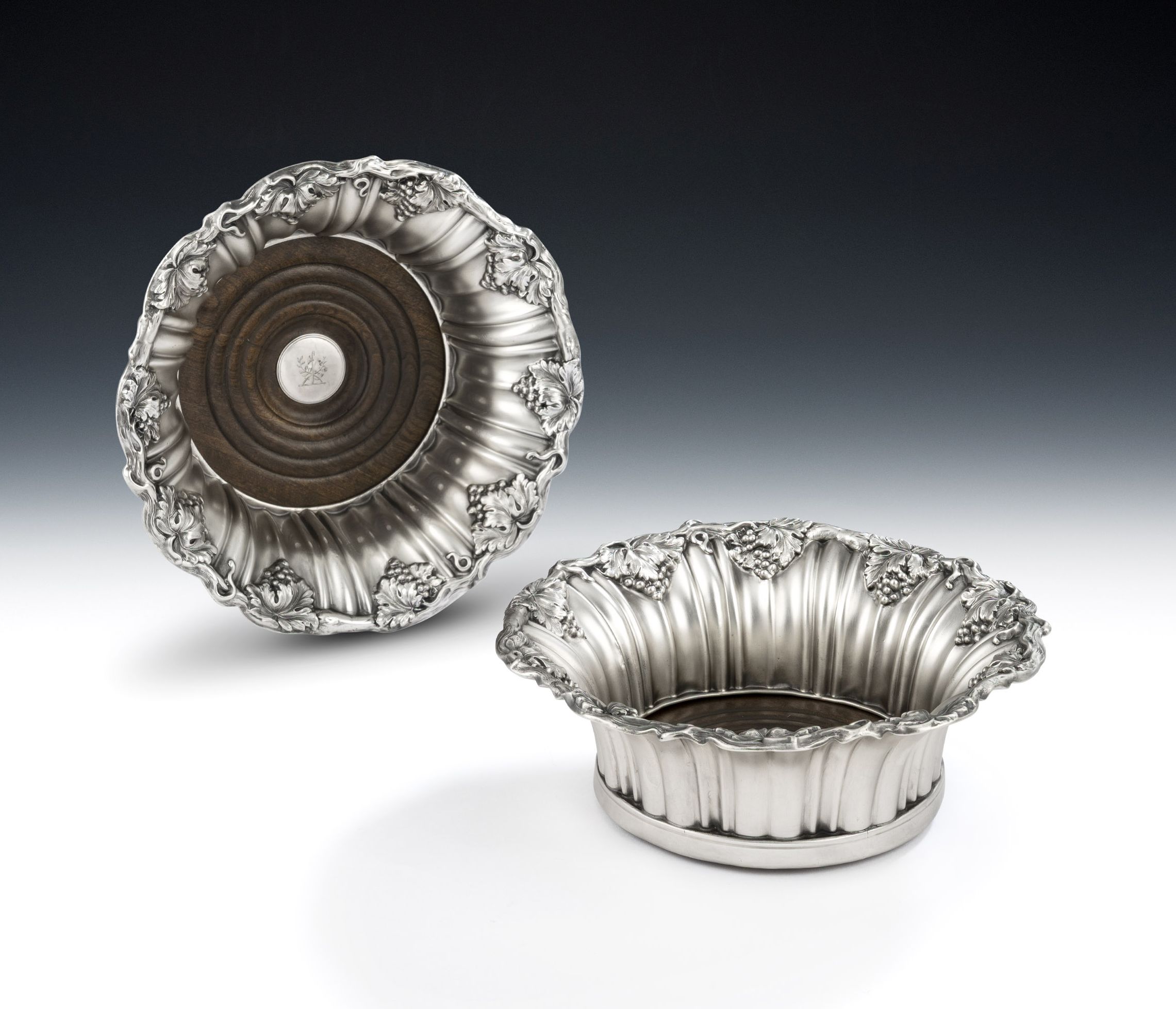
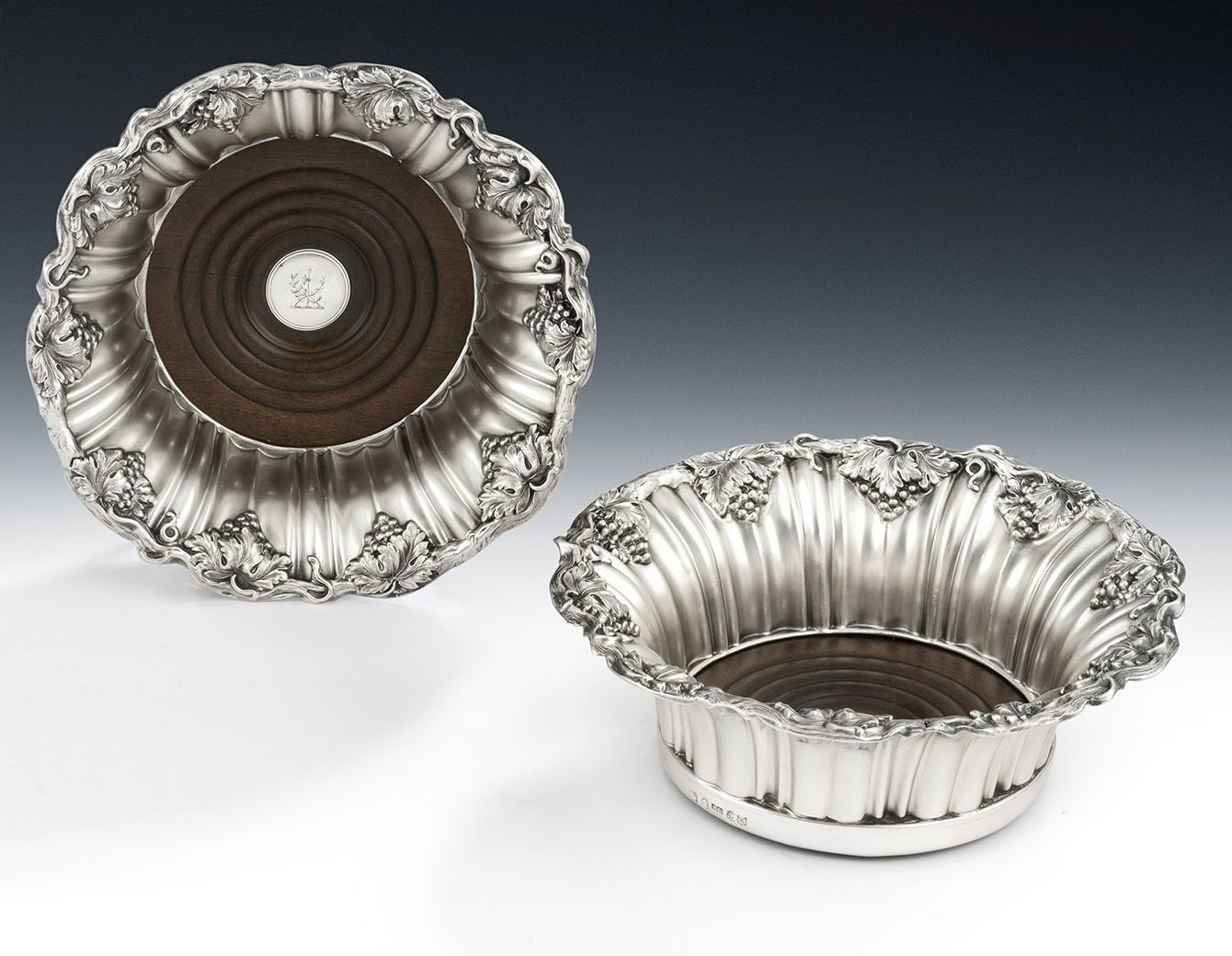
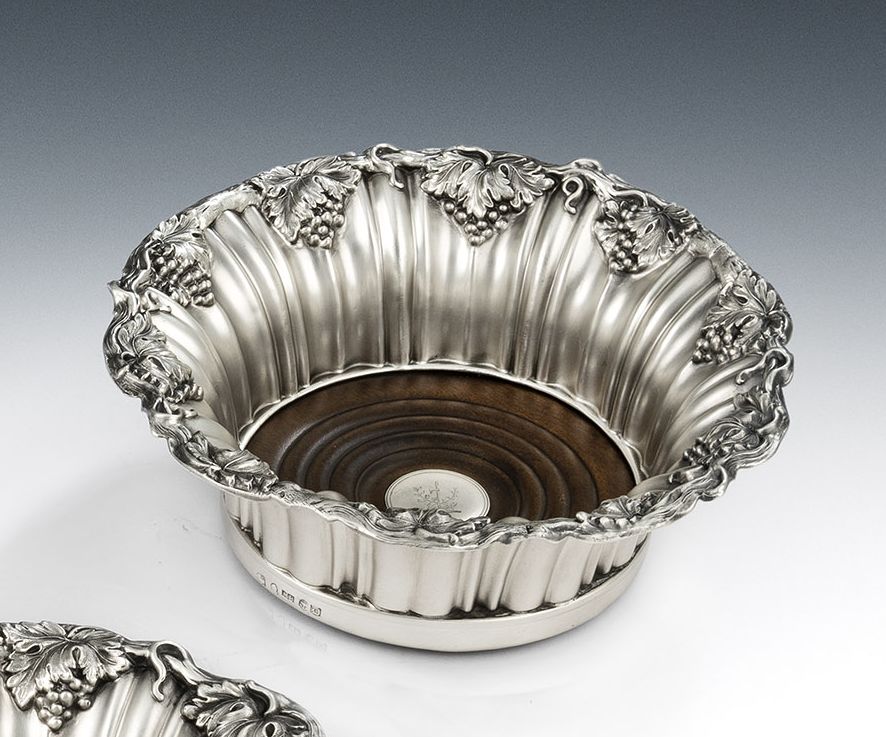
MATTHEW BOULTON. A very fine and unusual pair of George IV Wine Coasters made in London in 1827 by the Matthew Boulton Company.
375631
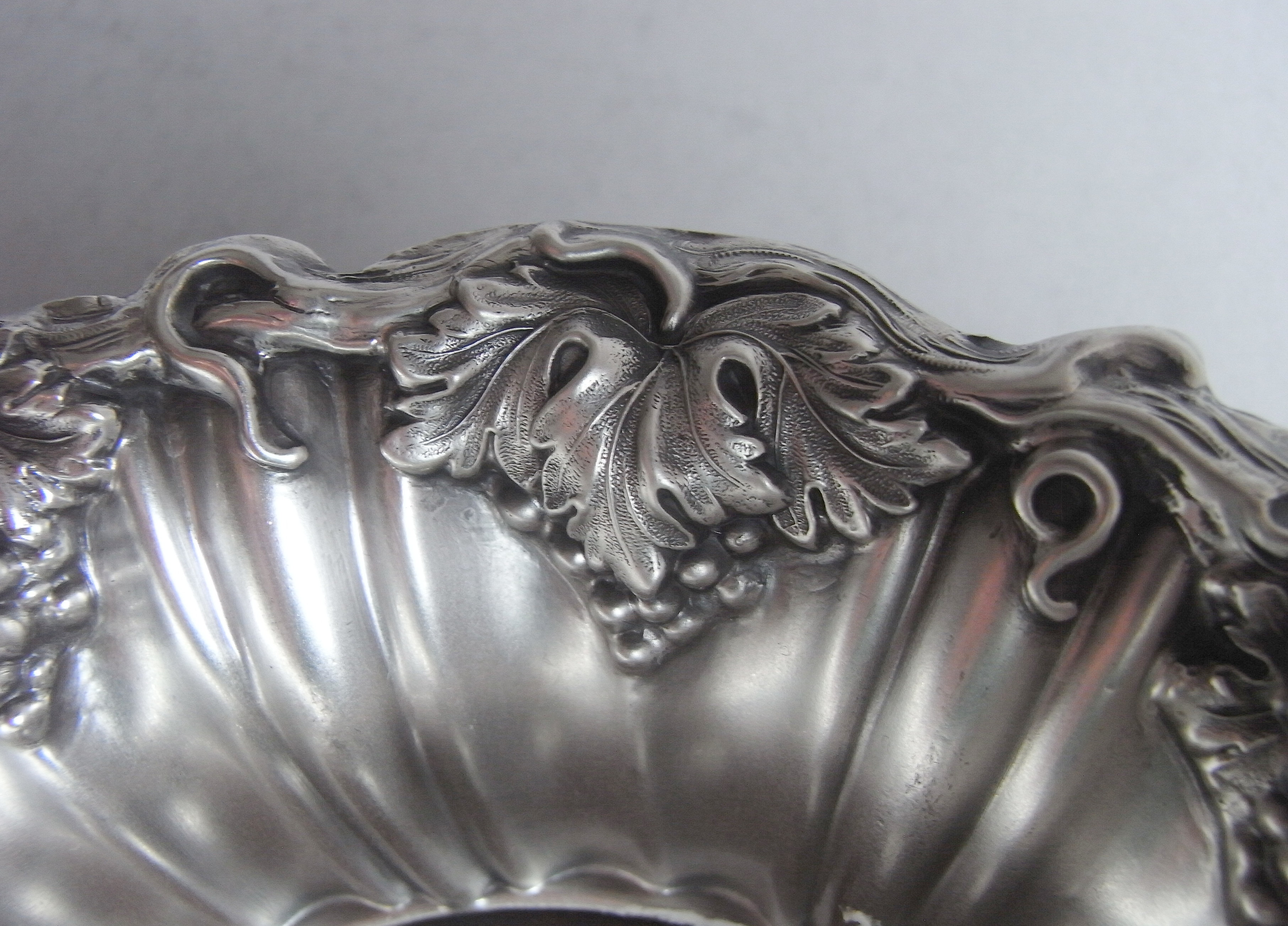
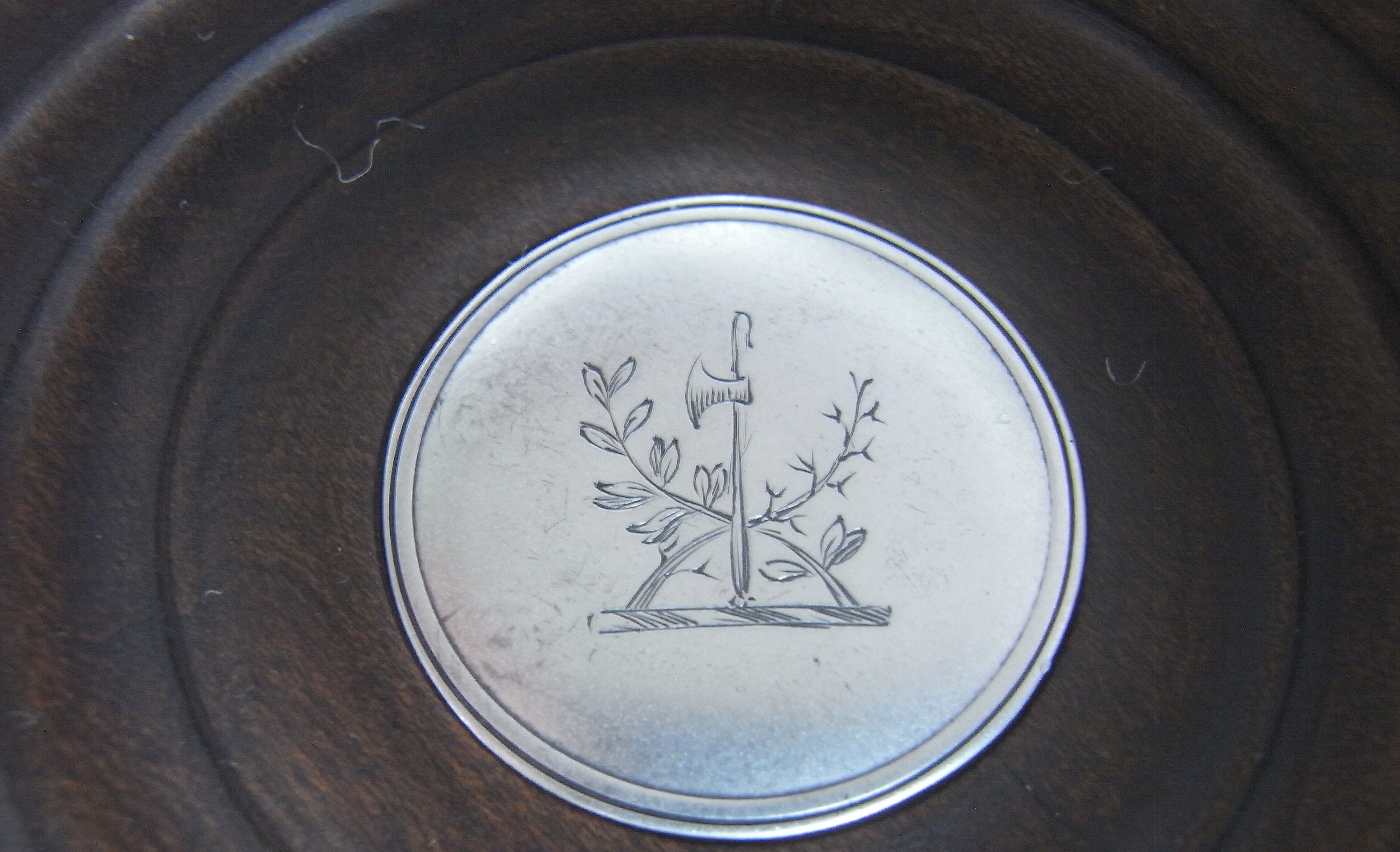
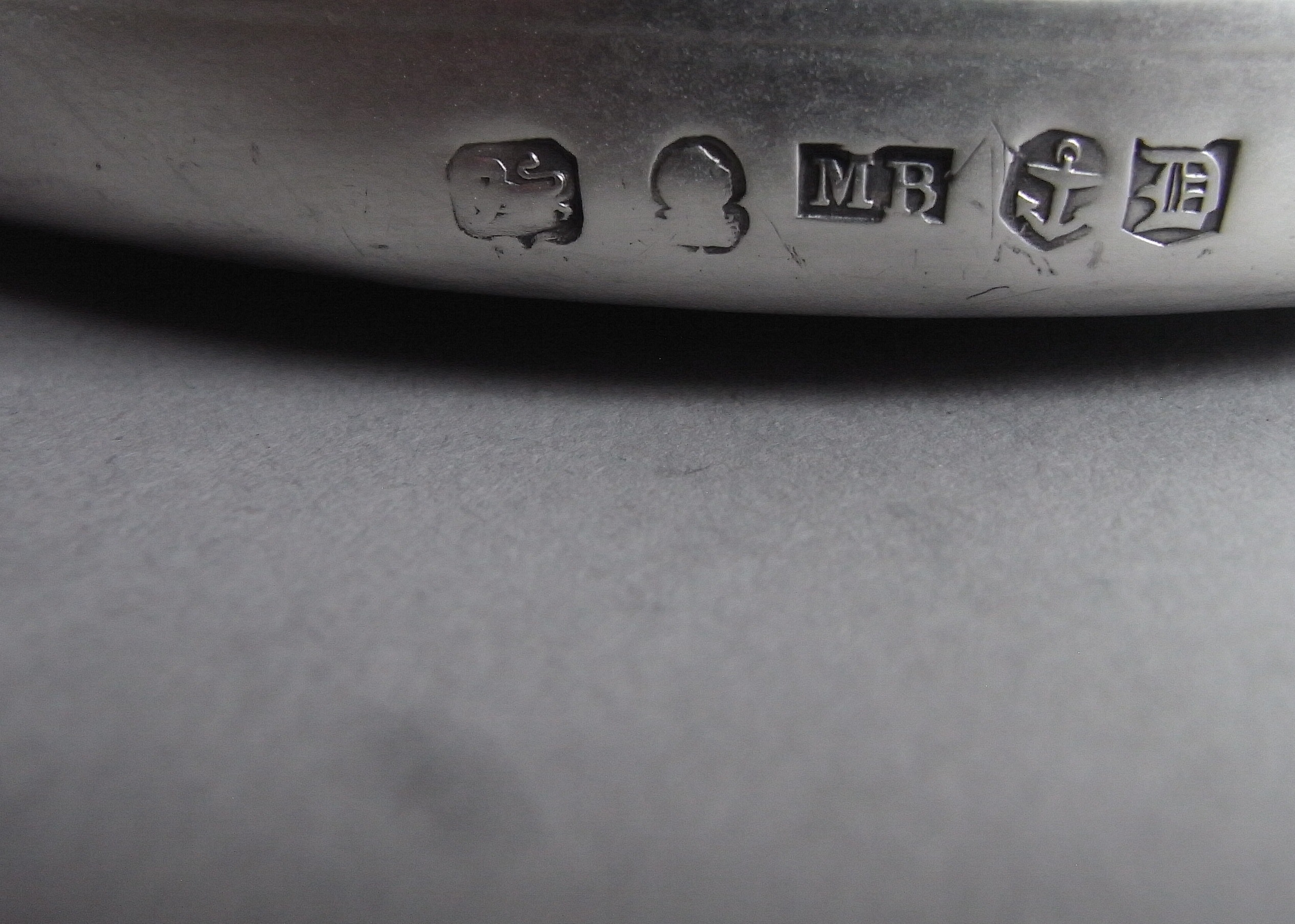
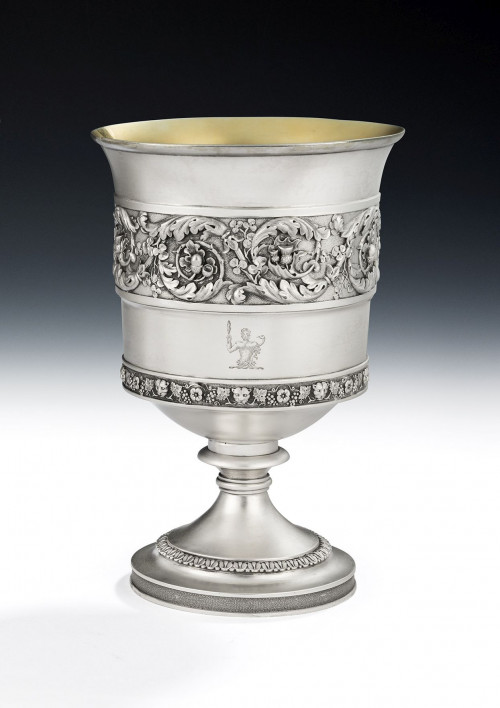
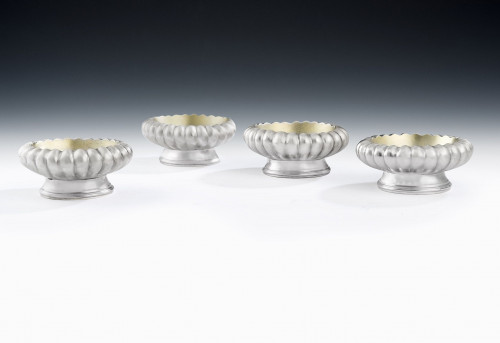
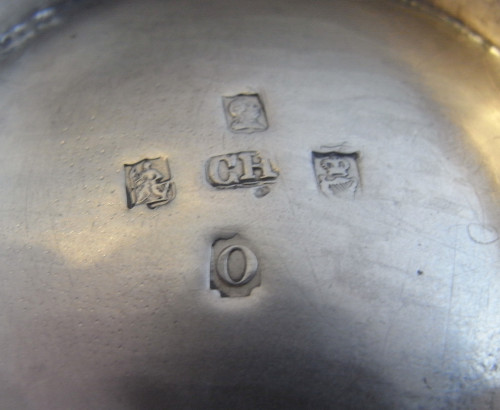
The Wine Coasters are modelled in a very unusual circular form, with high fluted, everted, sides decorated with raised trailing vines and grapes. The turned fruitwood bases are centred by a silver boss engraved with a contemporary Crest. The Crest is that as used by the Brattle family. Both are in excellent condition and are very well marked on the rim of the base. As you will appreciate, as well as being used as bottle or decanter stands, their deep form allows them to also be used on the table as baskets for a variety of uses, such as biscuits for cheese, grapes etc. Matthew Boulton was an exceptional silversmith and silver from his workshops is much sought after.
Matthew Boulton was an English businessman, inventor, mechanical engineer, and silversmith. He was a business partner of the Scottish engineer James Watt. In the final quarter of the 18th century, the partnership installed hundreds of Boulton & Watt steam engines, which were a great advance on the state of the art, making possible the mechanisation of factories and mills. Boulton applied modern techniques to the minting of coins, striking millions of pieces for Britain and other countries, and supplying the Royal Mint with up-to-date equipment.
Born in Birmingham, he was the son of a Birmingham manufacturer of small metal products who died when Boulton was 31. By then Boulton had managed the business for several years, and thereafter expanded it considerably, consolidating operations at the Soho Manufactory, built by him near Birmingham. At Soho, he adopted the latest techniques, branching into silver plate, ormolu ("gilt bronze") and other decorative arts. He became associated with James Watt when Watt's business partner, John Roebuck was unable to pay a debt to Boulton, who accepted Roebuck's share of Watt's patent as settlement. He then successfully lobbied Parliament extend Watt's patent for an additional 17 years, enabling the firm to market Watt's Steam engine . The firm installed hundreds of Boulton & Watt steam engines in Britain and abroad, initially in mines and then in factories. A painting of Boulton is attached and his importance in British History is reinforced by his image being on a former English £ 50 note.
Height: 2.5 inches, 6.25 cm.
Diameter: 7.25 inches, 18.13 cm.
RELATED ITEMS






 and other decorative arts. He became associated with James Watt when Watt's business partner, John Roebuck was unable to pay a debt to Boulton, who accepted Roebuck's share of Watt's patent as settlement. He then successfully lobbied Parliament extend Watt's patent for an additional 17 years, enabling the firm to market Watt's Steam engine . The firm installed hundreds of Boulton & Watt steam engines in Britain and abroad, initially in mines and then in factories. A painting of Boulton is attached and his importance in British History is reinforced by his image being on a former English £ 50 note.Height: 2.5 inches, 6.25 cm.Diameter: 7.25 inches, 18.13 cm.)